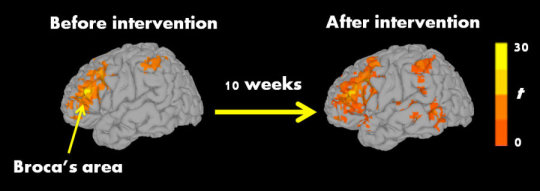
Change in functional connectivity for the experimental group of autism spectrum disorder participants as a result of the reading intervention. The functional connectivity of the Broca’s area with the rest of the brain and the change in connectivity from pre-to-post intervention during resting state show statistically significant changes in connectivity in the left hemisphere. The scale (right) represents significance in terms of T threshold.
“This study is the first to do reading intervention with ASD children using brain imaging techniques, and the findings reflect the plasticity of the brain,” said Rajesh Kana, Ph.D., associate professor of psychology in the UAB College of Arts and Sciences and the senior author on this paper. “Some parents think, if their child is 8 or 10 years old when diagnosed, the game is lost. What I stress constantly is the importance of intervention, and the magic of intervention, on the brain in general and brain connectivity in particular.”
Families taking part in the study received the intensive intervention — which was four hours a day, five days a week, for a total of 200 hours of face-to-face instruction — free of charge, says Kana.
Moreover, the amount of increased brain activation and functional connectivity of two core language areas — the left middle temporal gyrus and the left inferior frontal gyrus (which includes Broca’s area that enables a person to speak words) — correlated with the amount of improvement in reading comprehension for the intervention group of children with ASD.
“The ASD brain processing after intervention looks richer, with visual, semantic and motor coding that is reflected by more active visual activity and involvement of the motor areas,” Kana said.
Altogether, these results support the use of specialized intervention for children with ASD to boost their higher-order learning skills, and they add to the growing evidence of the plasticity (ability to alter function) of the young brains in children with ASD. The translational neuroimaging in this study increases the understanding of established neural networks in children with ASD, and this knowledge will help develop future targeted behavioral interventions.

About the author
Press Release
RELATED POSTS