


Recently, an MBA student asked us a simple question as part of his project. “Why do more companies not employ people with autism?” The question is obviously one for other companies to answer, but we couldn’t just say “ask them!” It was another way of asking us “How is it that you are able to create employment for people with autism while others can’t?”
Harry Specters was born by combining “a love for chocolates” and “a passion for creating jobs for people with autism”. The passion for creating jobs is natural – we have a son with autism. This passion drives the need to look at people with autism a bit differently. And when you do that, magic happens! The magic uncovers the untapped, under-utilised and un-nurtured skills that people with autism have. We are very proud of the fact that during the past two years, one of our biggest successes is to be able to create a supportive environment for young people with autism. We have worked with over 40 young people to date, and as a result we have a good idea of what skills they possess. We are not experts in the field of autism and are in the process of looking for experts who can further investigate this and make their findings available to other enterprises.
So what are the skills and characteristics that we have come to love and that makes them amazing workers
Great attention to detail. When it comes to chocolates, they are naturals for quality checks. They will notice the slightest scratch on a chocolate and the smallest fault in packaging. And they are not afraid to shout about!
Follow instructions Our factory rules are strict when it comes to hygiene. We explain these rules just once, or twice in some cases, and they observe the rules exceptionally well. For example, wearing uniforms, hairnets and gloves, and of course, washing hands before starting a new task in the factory or in a packaging area.

They do not engage in workplace politics. We have never experienced anything related to this in our small workplace. I believe they do not have any concept of politics etc. They struggle to understand the logic of “power” and its potential advantages for personal gains.
Most love social interaction. Even though they struggle with social skills, most of the people working with us love social interaction. However, like their mainstream peers, they retreat into their comfort zone if they fail to connect with someone. Sadly, this is mainly because we fail to understand their way of interaction, which is slightly different. They are more spontaneous, direct, and, at times, out of context. And what is wrong with that? Only because this is slightly out of line with our “social norms” we perceive this as unacceptable or odd. Personally, we just let them be themselves – chatting away, jumping from one topic to the next without any clear connection (at least in our mind)! At times, we have to step in and tell them to stop chatting and get on with their work while packaging chocolates. And at other times we encourage them to interact, knowing this is the only place, outside their home, where they feel comfortable enough to be themselves. In fact, feedback from some of the young people working with us, is that they want more people in the factory in order to have more social interaction. Like us, people with autism can be either introverts or extroverts or somewhere in between. In general, they love to interact, show keen interest in other people and their interests and love asking questions. As a result, they can work very well in a team.
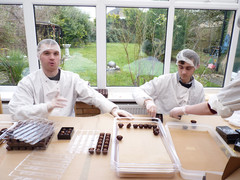
Loyal employees. Employee loyalty has three dimensions: turnover, attendance and organisational citizenship (individual behaviour and support that contributes to the organisational success). It is a major concern for employers. The value of loyal workers has increased because of a) competition for talent and b) the organisations are going flatter with more focus on employee empowerment. I feel very lucky sharing that on all three dimensions, we have zero problems. During busy times, our staff are happy to come on weekends and work for longer hours, not because of the monetary benefit, but because we provide them with the sense of achievement and fulfilment which they crave. They understand the fact that our business would not be able to function without them, and it is their sense of responsibility that makes them such loyal workers. They don’t take days off unless they have a genuine reason, they are punctual, and conscientious in their work. If they do not want to put in long hours, they will say so in advance, so you don’t have last minute absences to deal with – as is the case when dealing with mainstream employees. We have had 5 young people with autism working for us on and off, and all of them want to be with us forever
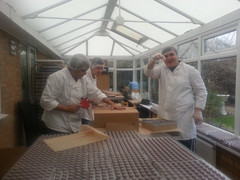
People with autism can be very creative. Their creativity in art is very well known. Tim Sharp is a world renowned artist whose work is exhibited in galleries worldwide. There are other examples of great artists. However, our business is chocolate, and in this area we found them to be problem solvers and creative. One of our employees is always keen on discovering new flavours for our chocolates. He bombards us with all sorts of flavour combinations for our ganaches depending on what he has read, seen, or eaten recently. Another young girl has a creative way of packaging chocolates. This creativity is also seen when they decorate moulds for slabs and Easter eggs
They are very It is common knowledge that people with autism like routine and structured tasks. Well most of us do like a structured approach and management gurus preach about developing structures around tasks, projects and operations. We have found that our staff are very natural when it comes to being structured. However, they do need to be told exactly what to do and when, and what are the exact steps that they need to follow. This ties in with skill # 2 of following instructions religiously. From making chocolates to packaging chocolates, there are hundreds of things that need to be done, some are sequential and others could be concurrent – and if you get your processes right, your operations are in the hands of some excellent people.
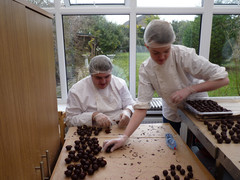
They never shirk their duties. I have heard many friends saying that they did nothing at work today or that they have achieved very little at the office today. I must admit while writing this, that the list of people includes me as well! Almost everyone does shirk from time to time. People with autism are different, they will never shirk. It is true that they may not do anything at all but they will show exactly that – do nothing. Unlike many others, who may pretend to work. This also ties in with their lack of hypocrisy.
In my experience money is not important for people with autism –they do not think that it is the be all and the end all. It is good to have, but not essential. Their sense of achievement is more important to them. Most of the time the pay our staff receive just sits in their bank accounts, according to their parents and carers. They are happy to come in on weekends or work longer without expecting an increase in their pay or compensation for overtime. It always surprises them when they receive extra pay for extra work!
They can be excellent supervisors. Like their mainstream peers, some are natural supervisors and others are more comfortable in being supervised. During the past two years, I was always worried about what would happen if I fell ill during a seasonal rush or in the middle of a large corporate order. I was reluctant to take on someone not on the spectrum to be my second in command, but didn’t think any of my current staff were up to the task as they all needed supervision. Luckily I have now found a young girl with Aspergers who is gradually taking on more and more responsibilities. She is also capable of supervising students coming in on work experience placements, and assigning as well as overseeing tasks being done by our regular staff.

Concluding remarks
It was never my intention to write such a long article. I started with 5 skills but somehow the list kept expanding as my husband and I kept thinking of more skills. I’m sure that there are even more skills and characteristics to share, and we will continue doing so as and when we come across them. Also, for these skills to surface and for people with autism to reach their potential, the work environment has to be supportive. They should feel that the workplace is theirs, somewhere they can be themselves and where their contributions are valued. If more organisations can offer such an environment, they would be amazed at the positive impact people with autism can make on their bottom line. We are very grateful to have found such excellent staff who are thoughtful, dependable and able to deliver.
To leave a comment about the article please visit the website here.
Source: Mona Shan: Harry Specters website: What skills do people with autism have?