

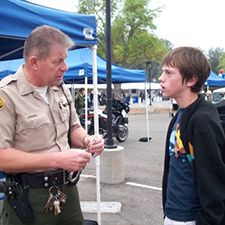
Be Safe the Movie – We recently ran a series on the topic of law enforcement and autism and we were received many personal messages about this emotive subject. The opinion piece, Autism and the Police – I am Frightened, in particular, received many comments from parents and caregivers of children and adults with autism.
One reader who contacted us was Emily Iland, an award-winning author, autism advocate and an Adjunct Professor in the Department of Special Education at California State University. She is also the mother of a young man with ASD (Autistic Spectrum Disorder.)
After reading our series, Emily got in touch with us to tell us about BE SAFE The Movie, of which she has written and directed. This is a video modelling DVD that shows teens and adults how to interact safely with the police. The positive models in BE SAFE can help anyone, and are especially important for individuals with disabilities or learning differences.
The website poses a question that every parent and teacher should be asking themselves:
‘What would your son, daughter or student with Autism Spectrum Disorder (ASD) do in an encounter with the police? Run? Fight? Shut down? Melt down? Those are scary possibilities. More and more news stories across the country focus attention on individuals with ASD and other developmental disabilities who have unsafe or even disastrous encounters with law enforcement officials.’
To get an idea of what BE SAFE The Movie is all about, please view the trailer below.

We wanted to learn more about BE SAFE and the wonderful work that Emily does and she kindly agreed to an interview during her busy schedule. Our interview with Emily can be read next.
Emily’s website can be found here www.emilyiland.com
For more information and updates about BE SAFE please visit the website, www.BeSafeTheMovie.com
Can you tell me a little about the early years with Tom [Emily’s son]? When was he diagnosed? What life was like?
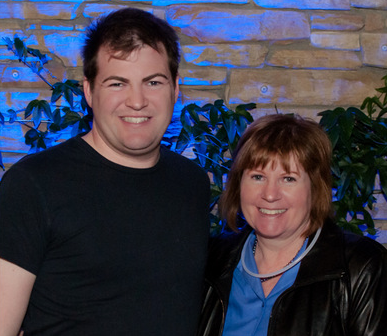
Can you tell me a little about the early years with Tom [Emily’s son]? When was he diagnosed? What life was like?
“Tom was diagnosed with autism at the age of 13, pretty late. I had wasted a lot of time in denial, thinking everything unusual about him was due to the fact that he was a boy/only child/genius etc. When I finally saw we needed help and realized that autism was the best explanation for his differences, I was told that he was “too smart” to have it. Granted, this was prior to 1994 and before our current concept of the spectrum. Once Asperger’s appeared in the diagnostic manual in 1994, the diagnosis was made. In actual fact, Tom had a language regression, and his official diagnosis is autism.”
Emily then told us that she then began to learn all that she could about autism, so that her son would get the help and support that he needed. This was while she was caring for her two other younger children, Lisa and Danny.
Emily shared with us that Tom was bullied during his childhood years, from the age of ten.
“I realized that children were afraid of differences they did not understand. Why would they understand Tom, I did not at first and I was his mom?! I realized that a lack of understanding creates distance, suspicion or even rejection. To help my kid have a good life, I would need to educate others and help make the world a little less harsh.”
It was during these years that Emily developed the experiential program called Appreciating Diversity. This allows children to sense what it feels like to have a disability, such as deafness, blindness or learning differences.
Emily further explained:
“Helping kids develop empathy is a powerful antidote to bullying. I put this program on in Tom’s school. Later, I helped my high school district bring the Yes I Can Program for Social Inclusion to our district, to help students with and without disabilities get to know one another and make friends.”
What was the spark that made you want to make this video?
“After learning what I needed to do to help Tom, I became active in the autism community and started working as a special education advocate. In the course of a decade I helped more than 300 families get the services and supports that their children needed.
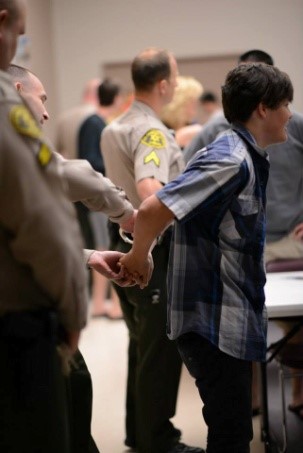
I will never forget they day I got a call from one of my clients, a mother telling me that her 14-year-old son was arrested at school for a very serious crime. The boy [who we will call Zach] functioned more like a 9-year-old, but the police did not understand this when they arrived on campus to arrest him. Zach waived his rights (which he did not understand) and confessed to the crime on tape, with no adults present. (The police were actually following correct protocol and procedures). The parents did not know any of this was going on until Zach was at the police station, having been taken away from school in handcuffs.”
Emily told that this case highlighted just how dangerous the legal system can be for young people with ASD and similar disabilities to be. During the same week and at the same school, two further boys were arrested and this is when Emily knew that it was time to take action and to come together as a community, therefore involving the police, families, schools and the justice system.
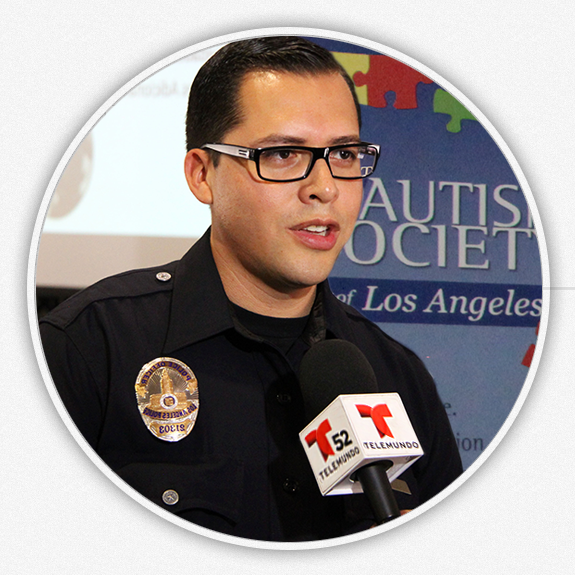
Emily helped to form a community action committee to address the issue of autism and the police, called CLEAR (Community and Law Enforcement Aware Response). And she chaired the CLEAR committee for six years. She is also the lead autism trainer for the Los Angeles Police Department (LAPD). Her new police training project, Experience Autism™ allows officers to participate in simulation activities in order to help them understand what it feels like to have different features of autism. Emily has personally trained more than 3000 officers to date.
Emily also told us that The CLEAR committee also focused on giving information to individuals with autism on how to be safe, and of how to interact safely with police.
Did you write the script?
Did you write the script?
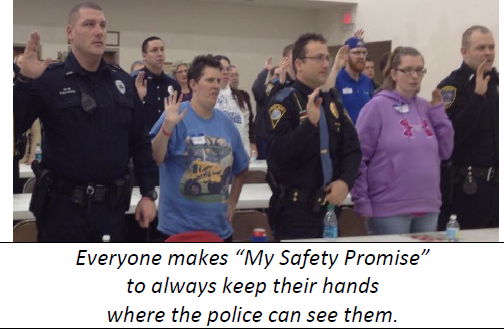
“I wrote the script for BE SAFE The Movie. Each movie episode teaches a specific safety skill (stay where you are, let the police see your empty hands, cooperate, tell the police about your autism) with the goal of preventing tragedies like the ones on the news.”
Who are the team behind Be Safe the Movie?
“BE SAFE is a passion project. I funded the movie myself, and then spent months writing more than 300 pages of teaching materials to go along with the Movie (which I then translated into Spanish with the help of many dedicated friends!)
On the production side, BE SAFE was made by and for young adults with autism and other disabilities who worked behind the scenes and in front of the camera. Joey Travolta of Inclusion Films is my co-executive director.”
Joey Travolta who is also an actor previously worked as a special education teacher. Inclusion Films is a workshop that teaches young adults with ASD and other disabilities, the skills that they need to work in the film industry. Joey became interested in BE SAFE from the very beginning, but it took five years to do the project.
Can you describe the process making BE SAFE The Movie? Who was involved?
“BE SAFE is a small independent educational film. Video modelling is the ideal teaching tool to show teens/adults specific, positive models of what to do in different encounters with police. I wrote the script, picked a producer, pitched the project, gave them a budget and left it in Inclusion Films’ capable hands until it was time to shoot! Dale Oprandy and his team designed the sets, cast the parts, rehearsed the scenes, and planned how to film each episode.
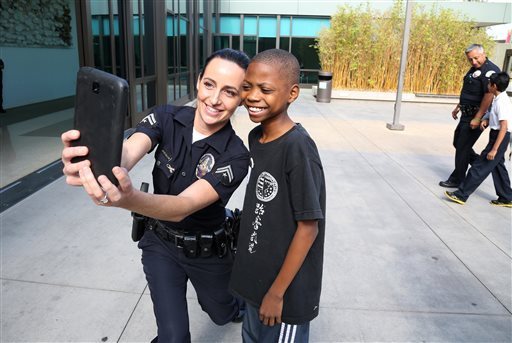
Active duty Bakersfiled CA Police and paramedics agreed to act in the film. They interacted with Inclusion Films actors with a range disabilities, which gives the movie great authenticity.
Joey Travolta and I held auditions for the role of the movie narrator. The young woman we chose, Tori Fritz, is the sister of a man with special needs. When I asked her why she was so clear in delivering her lines, she said she just pictured herself explaining the information to her brother.”
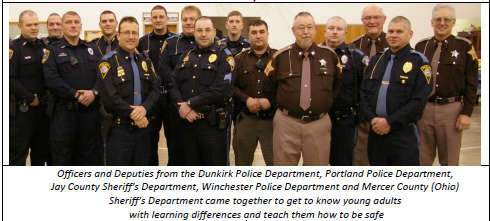
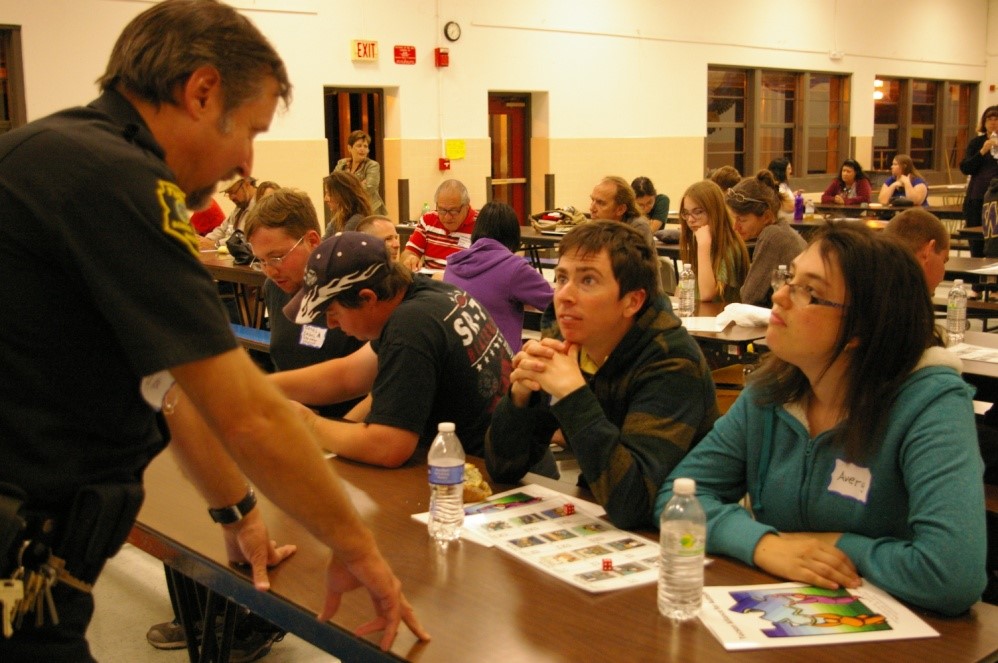
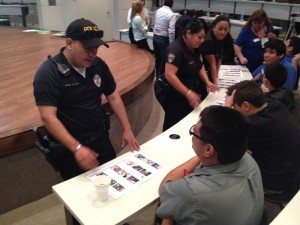
Emily then went on to tell us about hr new event, BE SAFE Interactive Screening that was briefly mentioned at the beginning of the article. These events bring together local police and the autism/disability community.
“They watch scenes from the movie, build safety skills, form relationships and learn from one another. Different organizations bring me in to do the event. I contact police in the area and ask them to participate, and the response has been marvellous.”
Emily told us that the screenings have been incredibly positive for all involved and Emily would dearly love to bring this program to every state in the country as well as abroad. More information can be found on the BE SAFE website.
Emily informed us that Chief Nathan Springer of the Portland Police Department wrote a thank you note after the BE SAFE Interactive Screening on March 10;
“Thank you for making this event happen. I really enjoyed it and felt like it was very beneficial. I have spoken to several of the officers that were at the training and all of them felt the same way. The Portland Police Department would be open to more training with all of you in the future. It would be nice to have a yearly event of fellowship. I know we have [another local event], but last night was more one on one. It was also nice meeting with parents. Thank you, if you have any future ideas, or events that the police department can help with (or learn from) please contact us.”
Sgt. Joshua L. Stephenson of the Portland Police Department also wrote to Emily saying:
“We as police officers normally do not get this type of hands-on experience with those with Autism let alone anyone with any type of disability. I can truly see how this type of training is beneficial not only to us as police officers but also those with special needs.”
What stories have you heard from other parents?
What stories have you heard from other parents?
“In response to BE SAFE The Movie, parents are amazed what their kids are able to learn just by watching. It is important to assume that everyone can learn (especially through video modelling) and make teaching safety a priority.
In regards to the interactive screenings, the parents are GRATEFUL that their children/teens/adults have the opportunity to meet the police in a safe environment and learn how to interact with police directly from the officers.
In general, parents are very concerned about safety, even fearful (you and I both know the feeling). Yet most people aren’t actively doing anything about the concern. My motto is “Don’t Leave Safety to Chance!” I created the BE SAFE the Movie and the Teaching Edition materials so parents (and teachers) would have the tools they need to be sure everyone can learn. We are talking about potentially saving a life!”
Can you tell me a little bit about your writing and where we can find your work?
“I started out as a stay-at-home mom enjoying being home with my 3 kids, Tom, Lisa and Danny. Once Tom was diagnosed, I spent a lot of time searching for reliable information about what ASD is, and how to help him. My sister was a special educator and we decided to write a book that answers the 1000 questions that new parents and teachers have…ASD from A to Z. I was disheartened to see that many Spanish speaking parents in the LA autism community and elsewhere did not have access to information that they needed to help their children. This inspired me to translate ASD A to Z into Spanish (it took me 550 hours of work – but is now out of print. I hope to have a new Spanish book next year).
As Tom grew up I turned my attention to other needs that presented themselves. I was very concerned about his reading comprehension issues (he could decode anything at all, but did not understand). I decided to go back to college and get a Master’s Degree in Special Education. No one was even discussing reading comprehension and autism in ANY of my master’s classes, so I did an independent study of the topic and published ‘Drawing A Blank, scholarly and practical information on reading comprehension and autism.’”
This book along with Emily’s other publications can all be found on Amazon.
Finally we asked Emily, if there was anything else that he would like to share with our readers.
“I will continue to focus on safety as my main theme. I also have a new book in the works on what parents can do today to prepare their children for a happy/productive adult life (I am writing it with Tom and a colleague of mine).
For his part, Tom would like to leave accounting and become a professional public speaker and conference presenter. Just yesterday he told me the theme of his presentations: Know Yourself. Love Yourself. Be Yourself. I am so proud of him!
My daughter Lisa is also involved in the autism field. She is a social coach for teens and adults with ASD, and helps with boyfriend/girlfriend relationships, social skills for work or college, and how to be a good flatmate or housemate. Her company is Social Bridge Seattle.”
We are happy to report that Tom now lives in his own apartment and drives.
We would like to thank Emily for taking the time to answer our questions.
For more information you can email Emily at emily@BeSafeTheMovie.com
Emily’s website can be found here www.emilyiland.com
For more information and updates about BE SAFE please visit the website, www.BeSafeTheMovie.com