

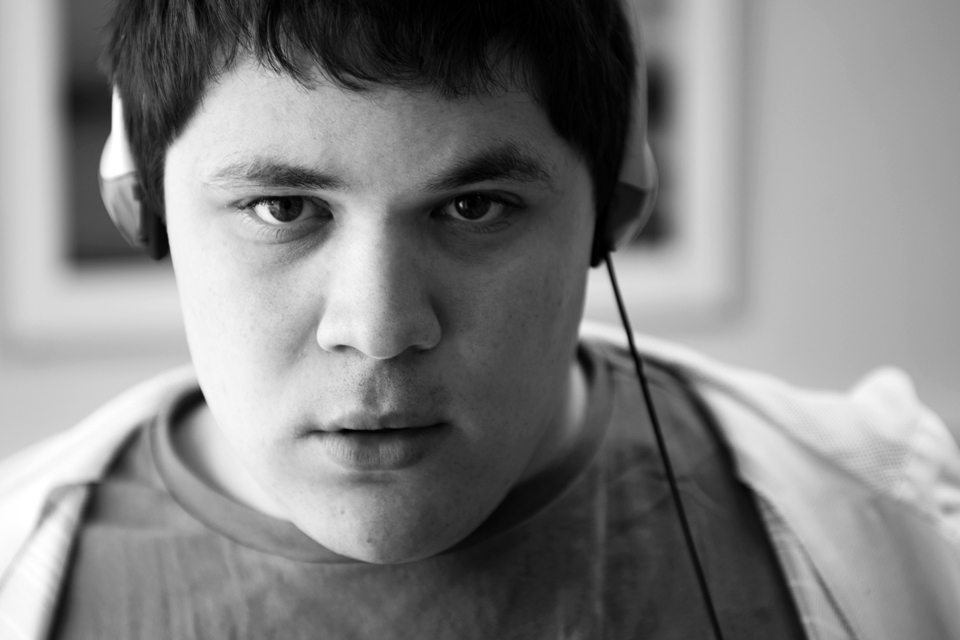
All this week we are discussing Samsung’s Look At Me App, with various viewpoints on eye contact being offered.
Julie Ellsmoor is a prolific autism blogger and mother to an adult son, John 26, who is on the autistic spectrum. During the week he lives in residential care with the Wirral Autistic Society. He has been a resident with them for over five years and requires round the clock, one to one support with all aspects of his care.
Back in 1986 when John was born there was very little provision for children with autism and not a lot of information on the condition either. For the first eighteen months I didn’t have a clue what I was doing. John screamed a lot and I screamed a lot. John didn’t sleep therefore I didn’t sleep. John didn’t want to be with other children and I didn’t want to be with other mothers, some who looked at me with pity in their eyes and some who tutted and nudged eachother if John screamed when their child came anywhere near him. I tried to ignore the tutting and nudging while attempting to calm John, drink cold coffee and eat a ginger biscuit without throwing up with anxiety. I think the collective mothers at the church playgroup were somewhat relieved when we stopped going.
Thankfully as awareness of autism has spread, things are very different today.
In the early days I was regularly given check lists by the various health professionals who we came in contact with. I was required to tick the boxes which best described John’s behaviour. I ticked most of them but all this achieved was to make me more anxious than I already was. What did all this mean for goodness sake? We had already established he was autistic from the first tick list and although I understood the need to collate information I felt that by continually ticking away it was just highlighting the differences between John and a non autistic child instead of helping us to better understand and support him in his world.
So what if he flapped his hands, loved spinny toys and refused to eat anything but fish cakes, baked beans and digestive biscuits? What difference would it make if he preferred to sit on his own in play group or god forbid wouldn’t or couldn’t give me any eye contact? I felt that there must be really good reasons why John did or didn’t do these things. It was clear to me that he was making choices which were important to him. Forcing him to go against his choices caused his anxiety levels to rise and usually ended in a meltdown. This was not about John being a naughty boy, on the contrary this was about John trying his best to stay calm and feel safe.
The eye contact thing always puzzled me the most. John looked at us sideways out of the corners of his eyes and from underneath his lashes. A bit like Princes Diana did except when she did it the world went bonkers, claiming she was shy and alluring in equal measure.
It never worried me and it didn’t stop him learning. He would look straight at me or his dad if he desperately needed or wanted something but mostly he looked at us sideways and we didn’t make an issue out of it.
However the lack of eye contact seemed a big problem to everyone involved in John’s education, especially the speech therapist or speech terrorist as we liked to call her. She wanted full eye contact at all times and was always very quick to point out to me that John absolutely ‘refused’ to give her any. I wondered why she was so insistent that John look directly at her. He did everything she asked of him and had learnt Makaton sign language very quickly.
I tried to talk to her about my own thoughts, that maybe John ‘couldn’t’ rather than ‘wouldn’t’ give her full eye contact. We all come across people from time to time who make us feel uncomfortable and what is our reaction, we avoid looking at them. I was convinced that in some way direct eye contact made John uncomfortable therefore he was minimising the risk of a meltdown with a self help technique worthy of praise, not negative criticism. I was eager to explore my theory with her but she was a very busy woman, I know this to be true because she kept telling me with monotonous regularity.
The teachers were not so rigid in their approach but clearly felt that it was a good sign if they did manage to eke out a few fleeting moments of eye contact with John during the day.
Throughout the week in class the children would be given merit awards as a way of encouraging and rewarding progress. I remember John receiving one for ‘Giving eye contact for 30 seconds‘. He was delighted to be singled out for his award, more because he is a show off and loved standing at the front of class while everyone clapped. His teacher explained that his 30 seconds of eye contact came when the juice and biscuits were being handed out. I fell about laughing. It was obvious to me that John must have been intent on getting a biscuit, probably two if he could get away with it and would have done anything if he thought it would increase his tally of biscuits.
Over the years I have read many books on the subject of autism, some of them very helpful and others not so much. I am fascinated by the condition and have found that the most informative ones are those written either by or in collaboration with an autistic person. To read first hand how the condition affects them has given me a much greater understanding of John.
It seems that my theory all those years ago regarding John’s reluctance to give direct eye contact was not too far off the mark. Some people experience Hypo or Hyper- vision and need coping tools to minimise the effects. It seems perfectly reasonable to me that avoidance is the best one.
John and many others autistic people use their peripheral vision to minimise the stress it causes to look directly into another person’s eyes. Eye contact has been described as painful, or that it feels like the other persons eyes are burning into theirs. Another person described how when they looked into someone’s eyes it caused their whole face to fragment, similar to a mirror exploding with shards of glass raining down. This terrified them and understandably they avoided eye contact at all times.
I will never know for sure what John experiences when giving direct eye contact but I do know that if it feels uncomfortable, painful or frightening then I am glad he made his choice at an early age to protect himself. I just wish that the speech terrorist had been more open to my suggestions; it might have helped some of the children cope better.
Having said all that, John’s desire to make us understand what he wants or needs is often much greater than the negative effects of direct eye contact. When this occurs he will come to me, wrap his arms around my neck, put his forehead against mine and look deeply into my eyes. John then hums softly, fluttering his eyelashes to tickle me as he knows it makes me laugh. We call them butterfly kisses, and you really can’t get any more direct eye contact than this. He never ceases to amaze me.
